Keywords
Advanced Nurse Practitioner, Advanced Practice Nurse, General Practice, Family Practice, Primary Care, Realist Review

Advanced Nurse Practitioner, Advanced Practice Nurse, General Practice, Family Practice, Primary Care, Realist Review
In Ireland, an ageing population with increasingly complex medical needs, combined with rising immigration and diminished workforce capacity, presents significant challenges for senior policymakers in healthcare planning and resource allocation (Collins & Homeniuk, 2021; Connolly & Flanagan, 2024; Connolly et al., 2022). Reflecting this growing and ageing demographic, a substantial increase in demand for general practice services is forecasted in the coming years (Walsh et al., 2021). To enhance capacity, many countries are exploring innovative workforce solutions to meet the escalating demand for healthcare (Maier et al., 2022; Scanlon et al., 2023). Expanded nursing roles are being integrated into general practice across numerous nations (Adams et al., 2024; Hamel et al., 2020; Schlunegger et al., 2023; Wheeler et al., 2022). International systematic literature reviews recognise the role of the Advanced Nurse Practitioner (ANP) in primary care in improving patient access, reducing waiting times and hospital admissions (Horton et al., 2025; Rossiter et al., 2023; Savard et al., 2025), and increasing patient satisfaction (Barnett et al., 2022). The ANP role is well established in primary care settings in countries such as Australia, New Zealand, the United Kingdom, and Europe (Evans et al., 2020; Strachan et al., 2022). Notably, 60% of the nurse practitioner workforce in New Zealand is employed in primary care, working across general practice and public-sector settings (Mustafa et al., 2021). This contrasts with Ireland, where the ANP workforce predominantly works in the acute hospital environment (Doherty, 2025). This paper presents a protocol for examining the ANP's role in general practice, understanding it in depth, and assessing whether it warrants inclusion alongside other countries in Irish healthcare.
Traditionally, general practice has been recognised as the primary point of access to healthcare and as a gateway to hospital specialists (Dunlea et al., 2023). As with acute hospital services, capacity in Irish general practice is under considerable strain, substantially impacting both patients and the GP community (Irish College of General Practitioners (ICGP), 2023). With an ageing population, a notable increase in demand for general practice services is anticipated in the coming years (Walsh et al., 2021). A recent preliminary study exploring the views of nurses working in general practice (GPNs) and General Practitioners (GPs) on expanding the nursing role found that 94% of GPs and 81% of GPNs regarded an expanded nursing role as a priority (Bury et al., 2021). Therefore, there is evident enthusiasm among clinicians to develop the nursing role within general practice.
Regardless of their practice area, ANPs possess competencies within their discipline that enable them to be senior decision-makers, work collaboratively, demonstrate clinical leadership and research skills, conduct advanced physical and mental health assessments, and implement evidence-based interventions, including prescribing, when necessary, for service users with complex and multiple needs (NMBI, 2025). In general practice, the first registered ANP was appointed in 2005 (Doherty, 2024). Despite the Department of Health (DOH, 2019) policy aimed at increasing the number of ANPs to meet emerging and future needs, the development of this role within general practice has been notably delayed. Anecdotal evidence suggests that since the first registered ANP in general practice in 2005, approximately 28 ANPs are now registered, with 25 candidate ANPs currently training (Loftus-Moran et al., 2024). Most registered ANPs working in general practice are trained within the setting, with only a small number (n = 3) trained in acute care (Loftus-Moran et al., 2024). The role is described as ‘generalist’, with ANPs in general practice providing autonomous care across various domains, including women’s health, chronic disease management, obesity, and preventive medicine (Loftus-Moran et al., 2024).
Sláintecare, Ireland’s current healthcare reform, is responsible for structured chronic disease programmes in general practice, including prevention programmes and opportunistic screening, and accountable for the recent extension of free GP care to qualifying individuals (Connolly et al., 2022; HSE, 2023). Crosbie et al. (2020) argue that Sláintecare has dramatically increased the workload on a service already strained by reduced workforce capacity and an ageing GP population. Real concerns now exist about the impact of this health reform and the lack of staff to meet increased demand (Connolly et al., 2022; Crosbie et al., 2020; Doolan & Prior, 2020). Despite international evidence demonstrating the ANP’s positive contribution to workforce capacity (Horton et al., 2025; Rossiter et al., 2023), the ANP's role in general practice remains unexplored in Ireland, and little is known about its impact on patient outcomes, service efficiency, and the delivery of healthcare policy.
Investigating the effects of the ANP in GP is endorsed by global nursing leaders, who acknowledge that nurses in primary healthcare should be allowed to work to the full scope of their practice (WHO, 2020). Nationally, the ‘Report of Expert Review Body of Nursing and Midwifery’ (DOH, 2022) highlights that implementing advanced nursing roles, including those in general practice settings, requires understanding their impact, as well as the barriers and facilitators. The report recognises that research and evaluation in this area are necessary. It is timely, therefore, as the ANP role in GP emerges, to intricately explore, understand, critically analyse, and impart knowledge that will enhance its implementation in Irish general practice settings.
Developed in 1997 by Pawson and Tilley, realist inquiry seeks to understand the theories behind social interactions and gain a deeper understanding of ‘what works for whom, in what circumstances, in what respect, and how?’ (Pawson & Tilley, 1997). This approach is gaining increasing popularity within healthcare, primarily due to the inherent complexity of healthcare systems (Hunter et al., 2022; Jack, 2022; Teeling et al., 2021). Realist inquiry seeks to understand complex social phenomena, such as the implementation of a new clinical role (e.g., the ANP role) within an existing primary care workforce (Eaton et al., 2025). The ANP role in general practice is a dynamic, context-driven service innovation (Adams et al., 2024; Maier et al., 2022; Schlunegger et al., 2023; Wheeler et al., 2022). However, implementing the ANP role may be considered complex for various reasons. In Ireland, there is no formal educational pathway or competency-based framework in place to support career progression for nurses working in general practice (Connolly & Flanagan, 2024). Equally, there is a scarcity of professional nursing leadership to guide the establishment of the ANP role in general practice (Loftus-Moran et al., 2024). To further complicate matters, each general practice is an entity with its own way of working. Therefore, the implementation of the role will vary depending on the specific context.
Realist inquiry examines how an intervention functions in a particular context. It does this by examining the causal relationships among the principles of context, mechanisms, and outcomes (CMOs) (Pawson & Tilley, 1997). In realist terminology, this is known as the ‘context, mechanism, outcome configuration’ (CMOc), and is often expressed as (C) + (M) = (O) (Pawson, 2013). A core task of realism is to unearth the processes that may enhance or impede outcomes (Cooper et al., 2017). Context extends beyond location and may encompass individuals within the programme, as well as interrelationships among stakeholders, the institution, and the wider infrastructure (Pawson, 2013). Mechanisms are processes that affect the implementation of the ANP role. They are responses and interactions to the intervention and provide a rationale for both intended and unintended outcomes (Greenhalgh et al., 2017). Outcomes refer to the intended and unintended results of implementing the ANP role, which depend on specific processes or mechanisms that prevail in a particular context. The use of realist inquiry will help elucidate how the complexities of implementing the ANP role in GP interact within specific contexts, producing both intended and unintended outcomes. Thereby understanding what works for whom, in what respects, and why (Figure 1).
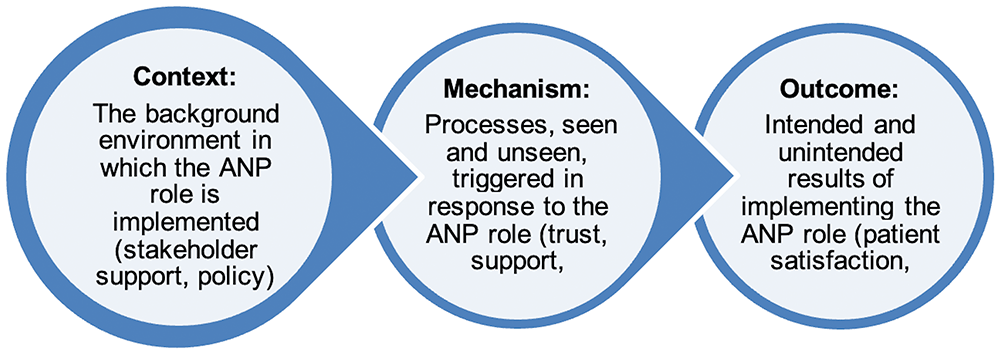
The following protocol outlines a framework for guiding the investigation into the implementation of the ANP role in general practice settings. The following key questions guide this protocol:
1 "What are the mechanisms through which the beliefs and attitudes of key stakeholders about the perceived value or demands of the ANP role in general practice shape the context for its integration into the practice team?"
2 "In what contexts do organisational and cultural factors act as enablers or barriers to implementing the ANP role in general practice, and what mechanisms within these contexts influence the outcome of successful or unsuccessful role implementation?"
3 "What are the outcomes of implementing the ANP role in general practice, such as impacts on patient outcomes, service efficiency, and practice performance, and how do specific contexts and mechanisms underpin these outcomes?"
To ensure a robust and credible review, the ‘Realist and meta-narrative evidence synthesis: Evolving Standards (RAMESES)' guidelines provide structure for realist researchers to carry out a review. This protocol follows the key stages recommended by RAMESES. As the realist review will be iterative, it is essential to note that these stages will overlap, with the researcher revisiting and refining each stage as needed. The stages are as follows:
1. Define the scope of the review and develop initial theories
2. Develop the search strategy
3. Data extraction and review of evidence
4. Synthesise evidence and develop conclusions
5. Refine theory iteratively and disseminate findings
1. Define the scope of the review and develop initial theories
Determining the scope of the review and developing initial programme theories will be a collaborative effort between key stakeholders and experts within the field. Critical to the initial steps in developing theory will be establishing a local reference group (LRG). During group consultation, initial hunches regarding the ANP role will be discussed. Hunches highlight plausible causal pathways and areas of potential relevance (Pawson & Tilley, 1997). Following the meeting, a high-level literature review will be conducted. This targeted search aims to map the evidence supporting the initial ideas, thereby ensuring that theories align with broader evidence (Fawkes & Ward, 2022). Preliminary theories, known as Candidate Programme Theories (CPTs), are initial hypotheses that propose how implementation of the ANP role in general practice might function under specific circumstances (Wong et al., 2013). Each CPT will be developed utilising the CMO configuration. By combining LRG insights with relevant literature, rough theories will begin to emerge, forming CPTs. The formation of CPTs is, therefore, a strategic process of identifying and locating evidence that aligns with the initial hypotheses and the intervention's contextual understanding. This iterative, purposeful approach enables the development of theories closely aligned with the ANP’s general practice-specific aims and challenges. These CPTs are theories or hypotheses based on the understanding that the implementation of the GP ANP role works/does not work because the actions of underlying mechanisms are activated only in particular contexts (Pawson, 2013).
2. Develop the search strategy
Once CPTs have been formalised in conjunction with the LRG and key literature, they will be presented to an expert panel for adjudication. An expert panel comprises members external to the research team who bring a range of expertise to the research topic, including lived experience, professional knowledge, policy expertise, and academic knowledge (Power et al., 2023). The expert panel will play a key role in overseeing the research process and will provide valuable perspective and insight at various stages of the review (Power et al., 2023). Once CPTs have been expertly adjudicated, they are referred to as Initial Programme Theories (IPTs). At this stage, a comprehensive scoping review will be conducted. Searching in a realist review is guided by the review's objectives and focus and is revised iteratively as data emerge (Wong et al., 2014). The search strategy will utilise a librarian's skills and involve multiple searches of medical and nursing electronic databases, including Medline, PubMed, CINAHL, EMBASE, and EBSCO. Following RAMESES guidance for realist reviews (Wong et al., 2013), the search strategy will be developed and refined iteratively as programme theories are adjudicated and tested. Searching in realist reviews is therefore theory-driven and adaptive, with search terms refined as understanding of relevant contexts and mechanisms develops, rather than fixed at the outset. This approach is consistent with peer-reviewed realist review protocols (Keown et al., 2024; Omisore et al., 2025). Table 1 below outlines the inclusion and exclusion criteria, based on the PICO framework, that will maintain the focus of the search strategy (Schardt et al., 2007). This framework represents the population under study, the intervention, and the outcome.
3. Data extraction and review of evidence
Data from the scoping review will be imported into Covidence. Covidence is a platform that streamlines systematic reviews, enabling reviewers to conduct them efficiently through title and abstract screening, full-text screening, data abstraction, and quality assessment (Hupe, 2025). Imported data will be scrutinised in line with the Preferred Reporting Items for Systematic Reviews and Meta-Analysis (PRISMA) guidelines. Two reviewers (PMcC and WT) will screen data based on title and abstract, followed by an eligibility assessment based on a full article review. A third reviewer (SPT) will adjudicate any discrepancy that may arise in the screening and eligibility process. A realist review draws on a wide range of sources, including grey literature and commentaries (Jagosh, 2019). While assessing the literature for eligibility in the review, data will be evaluated for relevance, richness, and rigour (Dada et al., 2023). Relevance determines whether the data can contribute to theory building, and rigour assesses whether the method used to generate the data is credible and trustworthy (Dada et al., 2023). Richness implies evaluating data sources for both ‘conceptual richness and thickness’ (Booth et al., 2013).
4. Synthesise evidence and develop conclusions
Once the data has been extracted and reviewed, the eligible literature will be analysed to develop theories and conclusions. To assist with evidence synthesis, a specialised qualitative data analysis software, NVivo, will be utilised. NVivo has features that help to code key concepts, identify C-M-O configurations, and recognise patterns in data (Bergeron & Gaboury, 2020; Omisore et al., 2025). Whilst synthesising evidence, a key tenet is to understand causation and how causal mechanisms are shaped and constrained by social context, thereby influencing the impact of the ANP role (Wong et al., 2014). To understand causation and the nature of mechanisms, realists employ ‘realist logic’ and analytic techniques to analyse their data (Duddy & Wong, 2023; Wong et al., 2013). Using the activities of retroduction and abduction, theories guide the extraction of knowledge about the ANP's role in GP from the literature, to uncover generative causation. Retroduction employs a non-linear process, sifting back and forth between programme theories developed and tested in the review, and the evidence included in the review (Dada et al., 2023; Jack, 2022). Once evidence is synthesised and conclusions drawn about the implementation of the ANP role in general practice, findings will be further refined before dissemination. Figure 2 provides an overview of the iterative stages and the constant refinement of theory across the review.
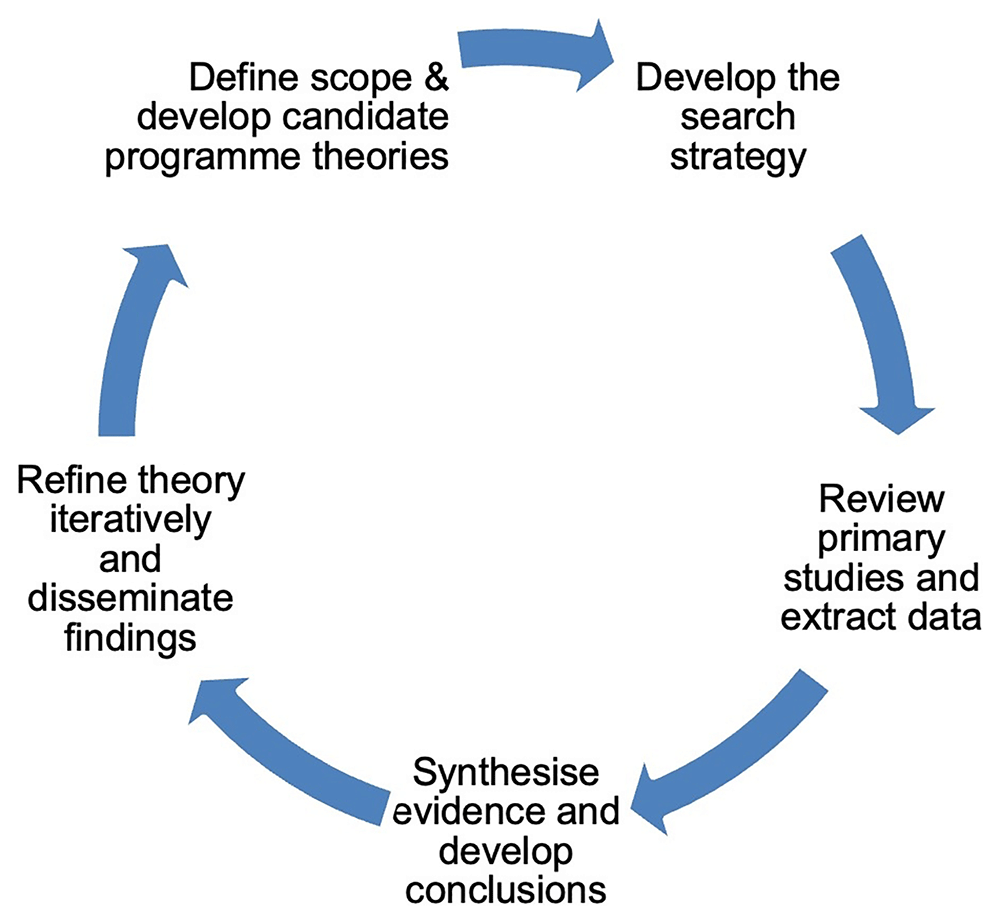
Adapted from Pawson and Tilley (1997) and RAMESES guidance (Wong et al., 2013), illustrating the iterative development and refinement of programme theory in realist review.
5. Refine theory iteratively and disseminate findings
Final refinement will occur in consultation with the Expert Panel. Robust theories informed by the review will be presented to the expert panel for refinement and further consideration and will become known as ‘programme theory’. When disseminating the outcomes of this realist review, the reviewers will adhere to the RAMESES reporting guidelines. Outcomes will be published in peer-reviewed journals and presented at conferences to interested audiences, both within academia and the healthcare sector. Furthermore, the outcomes of this review will inform the next phase of realist inquiry, specifically realist evaluation, where the reviewers test the outcomes in a real-world setting. It is anticipated that this realist review and the subsequent realist evaluation will culminate in the award of a PhD, thereby contributing to and expanding the body of scientific knowledge.
To conclude, this protocol outlines the key stages of a proposed realist review, which aims to examine the existing literature on the implementation of the ANP role in GP. This protocol outlines the step-by-step process for this review and acknowledges that it will be iterative, with stages overlapping. The protocol recognises that a realist review is a complex process and will require the use of recognised software, as well as effective communication between the reviewers and the expert panel. This protocol outlines a concise framework for investigating the implementation of the ANP role in Irish general practice settings, with the goal of understanding specifically what works for whom, in what circumstances, in what respects, and importantly, how.
Ethical approval is not required for this protocol, as it involves a review or synthesis of existing literature and no primary data collection.
This protocol has been registered in the PROSPERO database for systematic review and is currently awaiting a registration number, which will be added once available.
The Realist Review will be informed by the RAMESES (Realist and Meta-narrative Evidence Synthesis: Evolving Standards) project.
Provide sufficient details of any financial or non-financial competing interests to enable users to assess whether your comments might lead a reasonable person to question your impartiality. Consider the following examples, but note that this is not an exhaustive list:
Sign up for content alerts and receive a weekly or monthly email with all newly published articles
Register with HRB Open Research
Already registered? Sign in
Submission to HRB Open Research is open to all HRB grantholders or people working on a HRB-funded/co-funded grant on or since 1 January 2017. Sign up for information about developments, publishing and publications from HRB Open Research.
We'll keep you updated on any major new updates to HRB Open Research
The email address should be the one you originally registered with F1000.
You registered with F1000 via Google, so we cannot reset your password.
To sign in, please click here.
If you still need help with your Google account password, please click here.
You registered with F1000 via Facebook, so we cannot reset your password.
To sign in, please click here.
If you still need help with your Facebook account password, please click here.
If your email address is registered with us, we will email you instructions to reset your password.
If you think you should have received this email but it has not arrived, please check your spam filters and/or contact for further assistance.

Comments on this article Comments (0)