Keywords
Mental Health; Mental Disorders; Psychological Trauma; Women's Health Services; Depression; Pain.

Mental Health; Mental Disorders; Psychological Trauma; Women's Health Services; Depression; Pain.
There are high rates of co-morbidity between mental health difficulties and gynaecological and female reproductive system disorders.1 Several common gynaecological conditions are associated with high levels of psychological distress and impaired quality of life including endometriosis,2 polycystic ovary syndrome,3 adenomyosis4 and chronic pelvic pain.5 The bidirectional link between pain and depressive symptoms is well-established.6
Reproductive events can also trigger or worsen psychiatric or psychological distress. The risk of new onset or relapse of mental disorder in the peripartum period is well-described in the literature. The provision of services for perinatal mental health within the Irish maternity system has improved radically in recent years, though much work is yet to be done to fully address unmet needs for maternal, paternal and infant mental health.7 Other reproductive transitions have received comparatively less attention. There are increased rates of depressive symptoms during the menopausal transition,8 particularly so for those who have experienced surgical menopause,9 which is pertinent to the provision of integrated mental healthcare for a gynaecology population.
Premenstrual disorders, which include premenstrual dysphoric disorder (PMDD) and premenstrual exacerbation of an underlying, usual mental health, disorder (PME), are an interface between psychiatry and gynaecology that warrant more robust attention as assessment and treatment can span both specialties. PMDD is a mental disorder, as defined in the Diagnostic & Statistical Manual of Mental Disorders (DSM-5) in 2013, where cyclical symptoms, such as irritability, low mood, anxiety and mood swings, occur in the luteal phase of the menstrual cycle and impact quality of life and functioning.10 It has a prevalence of about 3–8% of people with a menstrual cycle.11 Differentiating PMDD from PME can be difficult12 and many individuals are misdiagnosed with other mental disorders. Those with PMDD experience high rates of suicidality, with over one-third having attempted suicide in their lifetime.13 First-line treatments include the oral contraceptive pill or selective serotonin reuptake inhibitors (SSRI antidepressants) but third and fourth line treatments include inducing chemical or surgical menopause, which require the expertise of gynaecology.14 To ensure accurate diagnosis and appropriate management of complex cases, interdisciplinary working between psychiatry and gynaecology is essential.
Despite the needs described here, many modern medical services are fragmented, depriving individuals of holistic care and leaving illnesses that affect multiple systems under-treated. The WHO has stated that:
“the focus on hospital-based, disease-based and self-contained “silo” curative care models undermines the ability of health systems to provide universal, equitable, high-quality and financially- sustainable care”.15
In Ireland, two core healthcare policy documents, the Sláintecare and Sharing the Vision reports, have defined greater integration of physical and mental healthcare as a key priority.16,17 The existing inclusion health model has also emphasised the importance of integrated care and given consideration as to how that can be implemented (The Royal College of Physicians Ireland, 2026). Failure to provide integrated care disproportionally impacts the most marginalised groups in society. Likewise Sharing the Vision made a range of recommendations for the development of mental health services, and the importance of integrated care. While the majority are related to general services at primary and secondary care, there were two recommendations relating to Women’s Mental Healthcare.
Consultation-liaison psychiatry (CLP) is the sub-speciality of psychiatry that works at the interface between medical specialties and mental health. These services operate within acute general hospitals, although in Ireland, current resourcing levels fall short of national and international guidance.18 An important role of the consultation-liaison psychiatrist is to promote the integration of mental and physical healthcare.19
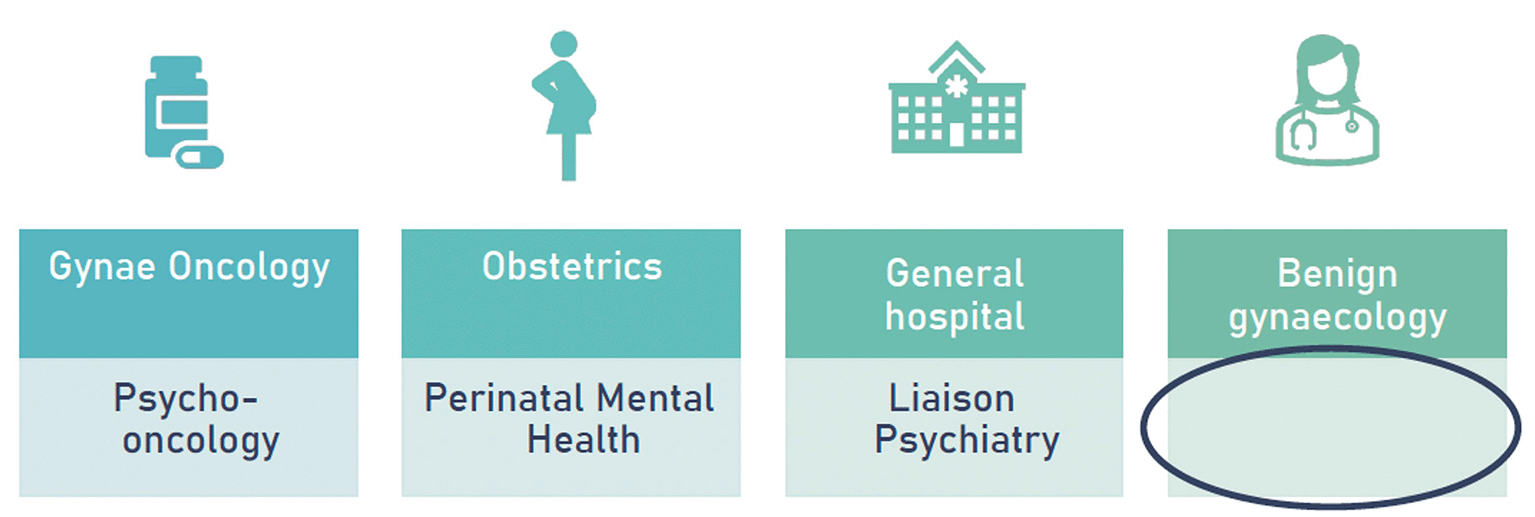
The three Dublin maternity hospitals include large gynaecology departments with a combined outpatient gynaecology attendance of over 40,000 appointments annually.20–22 As these hospitals do not have access to a wider CLP service, there is no integrated mental health service available to this large population of gynaecology patients. This contrasts to the services available to women attending the maternity service in same hospital who can access the embedded perinatal mental health service during pregnancy and up to one year postpartum.23 This also differs to the services available to patients attending general Model 4 and Model 3 hospitals for treatment of any physical health conditions who have access to the CLP services, and those who have gynaecological cancers who have access to the Psycho-Oncology Services which are integrated with cancer care in the eight Cancer Centres in Ireland. Members of this research group are currently completing a systematic review to consolidate the evidence base for the delivery of integrated mental healthcare with women’s health services.24
This overview of service provision is outlined in Figure 1.
We will draw together the data from the literature to develop a model for the delivery of integrated mental and physical healthcare in the Women’s Hospitals and gynaecology hubs. Drawing on the examples of successful models in the Irish context such as the perinatal, psycho-oncology and the Beaumont pelvic floor services, we will pilot a stepped care model for delivering integrated mental healthcare via CLP in gynaecology services.
This study aims to answer the question: can an evidence-based and trauma-informed mental health service integrated with existing women’s health services be effective in improving health care outcomes for women?
Th research has the primary aim: to develop a framework for the integrated delivery of women’s mental and physical healthcare by identifying the needs, context, and existing services available in this area. It will support the development of evidence-based, trauma-informed mental health services to meet these needs and build a network of services and professionals to promote the development of these services and evidence-based interventions. This will comprehensively assess the needs, context, and existing services available in this area. It will develop a range of educational tools for clinicians working within gynaecology. It will provide proof of concept for evidence-based and trauma-informed mental health service (the EQUATE clinic) to meet the psychological needs of women attending a benign gynaecology clinic. It will design a bespoke integrated screening measure to identify and measure mental health needs, and to inform a tiered support system.
This project will have the following secondary aims:
a) To develop a screening tool which can be utilised in a gynaecology clinic to identify those women who would benefit from mental health supports in a stepped care model;
b) To pilot a benign gynaecology CLP service to provide proof of concept for the models of integrated care and to evaluate the impact of this service.
This study will assess the efficacy and acceptability of a clinical service pilot benign gynaecology clinic with assessment of patients, examining acceptability, engagement and outcomes.
This study will design and implement a pilot mental health service for pelvic pain in the benign gynaecology clinic. The service will assess patients, examine engagement, and assess outcomes. We envisage that this gynaecology and Consultation-Liaison Psychiatry (EQUATE) service would sit within the gynaecology hub at the Rotunda Hospital to facilitate integrated care. In the first instance, this service would aim to provide specialist input to patients with the conditions most in need of integrated care. This project will have two components: (a) screening and (b) service.
Robust screening is an important component of ensuring that the service is sustainable and reaches those who need it. Not everyone who has symptoms of depression or anxiety needs a psychiatrist, and many need support that is not necessarily at a specialist level. We will develop a screening service for the clinic similar to that provided by the IMPARTS service at King’s College Hospital London.25,26 This service provides screening for all people attending medical outpatient clinics via a waiting-room screening tool. This is administered using an iPad and includes validated scales measuring symptoms of depression or anxiety. This study will implement a similar screening model for gynaecology clinics which will be matched to a tiered system for interventions as follows (see Figure 2):
a) those with low levels of symptoms do not require intervention;
b) Those with mild-moderate symptoms will receive sign-posting to the appropriate community supports, with a letter to their general practitioner and other professionals as necessary;
c) Those with moderate-severe symptoms would be referred to the specialist EQUATE clinic;
d) Those with evidence of acute risk or high levels of suicidality would be referred for emergency care.
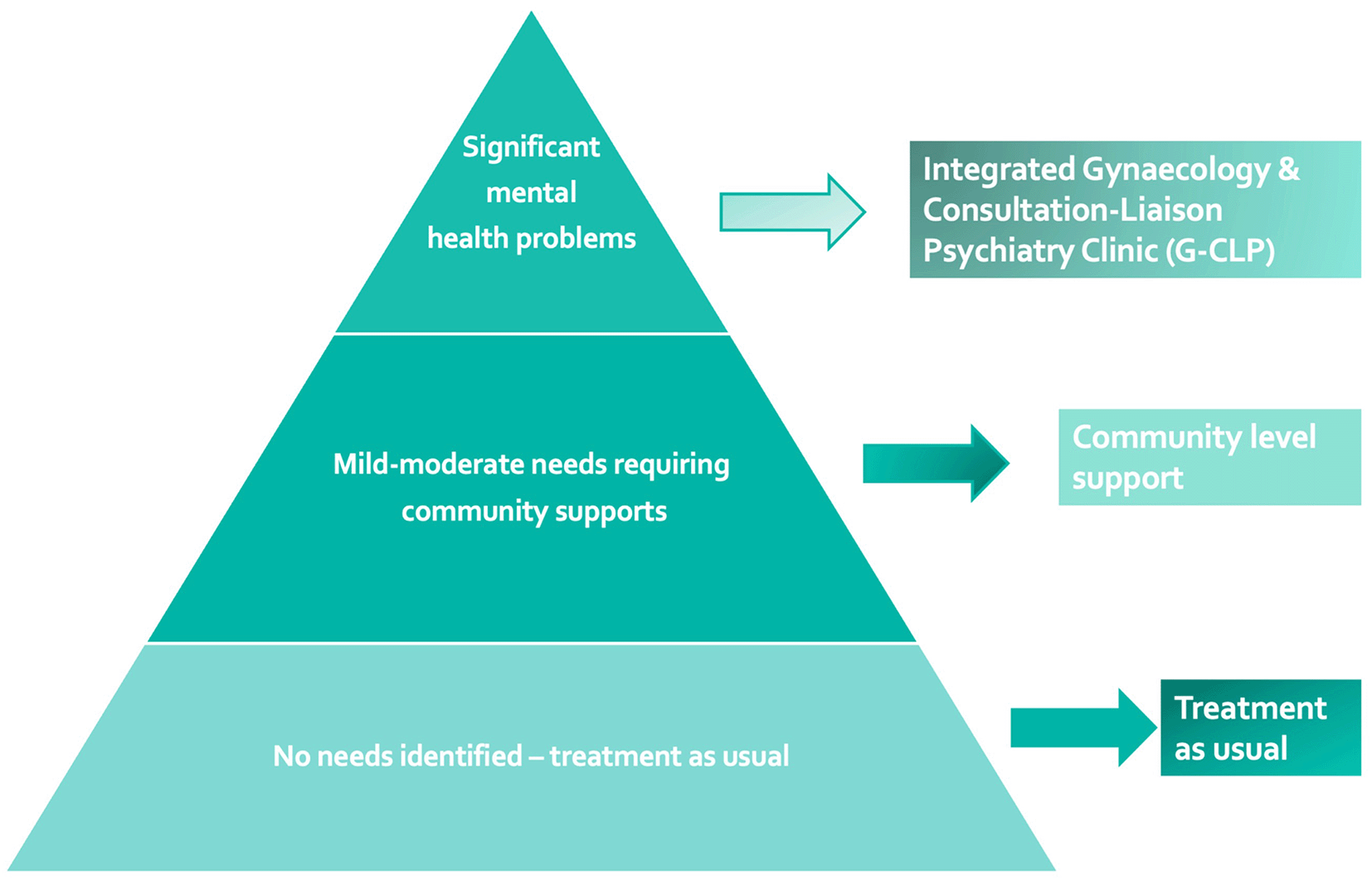
The system will identify those who require intervention and tailor the intervention to each woman’s needs. It will supply relevant information for those who require support for mild-to-moderate difficulties and share this information with their general practitioner and other professionals as necessary.
The following screening measures will be used (for those who proceed to the EQUATE clinic, these will be baseline measures used to assess change in clinical status over time):
We will measure depressive symptoms using the Patient Health Questionnaire (PHQ-9), a 9-item self-report questionnaire (range 0 to 27) with a score ≥ 10 having a high specificity and sensitivity for depressive disorder.27
To assess symptoms of anxiety, we will use the Generalised Anxiety Disorder 7-item scale (GAD-7), a 7-item self-report questionnaire (range 0–21) with a score ≥ 5 having a high sensitivity and specificity for at least mild anxiety disorder.28,29
The experience of pain will be assessed using the visual analogue scale (VAS). This simple measure asks respondents to rate their pain on a 100-mm line from 0 (no pain) to 10 (worst pain imaginable). It has been validated in gynaecology populations.30,31
Functioning will be measured using the EQ-5D. The EQ-5D is a self-report measure of health-related quality of life across five dimensions: mobility, self-care, usual activities, pain or discomfort, and anxiety or depression. In addition, participants are asked to rate their current health on a scale from 0–100 (worst to best). The instrument allows for the calculation of quality-adjusted life years (QALYs).32
population. We will use the ENDOPAIN4D Questionnaire, a validated tool for measuring symptoms in endometriosis.33 This four-dimensional structure has good internal consistency across the following domains: pain-related disability, painful bowel symptoms, dyspareunia, and painful urinary tract symptoms. These four subscores can be summed to obtain a total score ranging from 0 to 94.34,35 The minimal clinically significant difference in the global score is 11.36
We will assess the acceptability of the screening by including a question on their experience of the screening process.
For those referred to the EQUATE clinic, their outcomes will be evaluated as follows:
1. Population
2. Outcomes
3. Acceptability to women
4. Acceptability to gynaecology healthcare providers
1. Population
This will involve defining the target population and describing the characteristics of the population of women referred to the service, including the following sociodemographic and clinical characteristics:
a) age
b) relationship status
c) ethnicity
d) education status
e) employment
f ) socio-economic status based on the Pobal Deprivation Index based on their Eircode and the small area deprivation indices for 2022. (https://www.pobal.ie/pobal-hp-deprivation-index/)
g) Parity
h) Primary gynaecology diagnosis
i) Psychiatric history/diagnosis
j) Other diagnoses
k) Medications
l) Health service use (ED attendance)
2. Outcomes
The following outcomes will be measured at two time points: baseline assessment or screening (T0) and six months (T1). All scales are described in detail above under Screening.
a) Depressive symptoms: Patient Health Questionnaire (PHQ-9).
b) Anxiety symptoms: Generalised Anxiety Disorder 7-item scale (GAD-7).
c) Pain: visual analogue scale (VAS).
d) Functioning: the EQ-5D.
e) ENDOPAIN4D Questionnaire for Endometriosis-related symptoms. (when relevant)
Retention in the study will be facilitated by participants being involved in the clinical service. For those lost to follow up, we will be unable to include their scores.
3. Acceptability to women
We will assess the intervention’s acceptability by inviting the women who attend to complete an anonymised survey about their experience of the EQUATE service and integrated mind-body care.
User feedback will be obtained in two ways.
a) Firstly, a random sample of participants will be asked to complete a short feedback form. This form will consist of open-ended questions about aspects of the programme that they liked or disliked and related to coping with their problems.
b) In addition, the Client Satisfaction Questionnaire 8 (CSQ-8) will be utilised to assess satisfaction via a validated scale. The CSQ-8 is an 8-item measure of service satisfaction. Participants rate the quality of the service and their satisfaction with the services provided on a 4-point Likert-type scale with varying response options (e.g., “How would you rate the quality of the service you received? 4 = Excellent, 3 = Good, 2 = Fair, or 1 = Poor). Items will be summed up for a total score ranging from 8–32, where higher scores indicate greater satisfaction.37
4. Acceptability to gynaecology healthcare providers
Acceptability to referrers will be measured by focus groups. We aim to recruit up to 8 participants, which will be the optimal way to generate discussion and be manageable. The focus group will be led by a researcher independent from the pilot service delivery. Potential participants will be informed of the focus group dates and the study information sheet.
Descriptive statistics will be used to show the distribution of the participants’ characteristics and clinical outcome scores. The Mann–Whitney U test will be used to compare the numerical variables. The chi-square test will be used to analyse categorical variables. Logistic regression analysis will be performed to examine the association between mood, anxiety and pain. Paired t-tests will be performed to draw comparisons in the outcome variables between T0 and T1. All tests will be two-sided, with a significance level set at 95%.
In the group who attend the clinic, the change in these measures from T0 to T1 will be assessed using a paired t-test, and a multivariable model will be developed to examine the change over time after controlling for the relevant confounding variables.
All quantitative data will be analysed using SPSS (Statistical Package for the Social Science) for Windows/Mac.
The qualitative data from the referrer acceptability focus group will be transcribed, entered into NVIVO, and analysed using a thematic analysis approach. Similarly the open text portions of the patient questionnaire will be analysed via NVIVO, again utilising thematic analysis.
Ethical approval is in the process of being sought from the Research Ethics Committee of the Rotunda Hospital. This study will be conducted in line with the ethical standards of the relevant national and institutional committees on human experimentation and with the Helsinki Declaration of 1975, as revised in 2013.
All participants will be required to provide written informed consent and will be informed of their right to withdraw from the research until the point of data anonymisation for analysis. There will not be any minors included in this study.
The Steering Committee will provide oversight of this study and will include a range of clinical, academic and managerial expertise relevant to the study.
It is a key part of this work that the findings are appropriately disseminated to policymakers, clinicians, academics and the public. Presenting research at conferences is often a useful way of getting additional academic opinion on the work which can help to regard it in a new light. The study’s findings will be disseminated at the relevant international conferences. We will seek to publish in Open Access Journals, as open access publication is important as it allows the open availability of findings to readers: clinical, academic and the public. Communication to the scientific community will occur in the form of conference presentations, training workshops, training presentations, scientific articles, presentations at third-party meetings. Communication to the lay public will occur through presentations, discussions at carers’ and users’ workshops, media articles, discussion forums, website postings, and training events. These will be carried out using different techniques: presentations, discussions, small group teaching and large group seminars. We will ensure that the communication plan is working, based on participation and interest in the above-mentioned forums and events. However, practice change will take time and will only be measurable 3–5 years after the research findings are available.
Provide sufficient details of any financial or non-financial competing interests to enable users to assess whether your comments might lead a reasonable person to question your impartiality. Consider the following examples, but note that this is not an exhaustive list:
Sign up for content alerts and receive a weekly or monthly email with all newly published articles
Register with HRB Open Research
Already registered? Sign in
Submission to HRB Open Research is open to all HRB grantholders or people working on a HRB-funded/co-funded grant on or since 1 January 2017. Sign up for information about developments, publishing and publications from HRB Open Research.
We'll keep you updated on any major new updates to HRB Open Research
The email address should be the one you originally registered with F1000.
You registered with F1000 via Google, so we cannot reset your password.
To sign in, please click here.
If you still need help with your Google account password, please click here.
You registered with F1000 via Facebook, so we cannot reset your password.
To sign in, please click here.
If you still need help with your Facebook account password, please click here.
If your email address is registered with us, we will email you instructions to reset your password.
If you think you should have received this email but it has not arrived, please check your spam filters and/or contact for further assistance.

Comments on this article Comments (0)