Keywords
Cancer, Exercise, Rehabilitation, Prehabilitation

Cancer, Exercise, Rehabilitation, Prehabilitation
An estimated 44,000 people in Ireland are diagnosed with cancer each year, and approximately 200,000 individuals are now living with and beyond a cancer diagnosis (Ireland 2022). As survival rates improve across many cancer types, a growing population of survivors face the long-term physical and psychosocial consequences of their disease and its treatment. Addressing the physical burden of cancer survivorship is therefore both an area of concern from both clinical and public health perspectives.
Cancer literature has identified the risk of developing cardiovascular disease (CVD) among survivors with breast, prostate and endometrial cancer, which otherwise have high survival rates (Sturgeon et al. 2019). The CVD risk is hypothesised to be related to existing CVD, pre-existing CVD risk factors, cancer-treatment related cardiovascular toxicity and/or pre-existing or treatment-related lifestyle toxicity (Kirkham et al. 2019). As cardiac rehabilitation is an integral component of care among heart disease patients, there has been recognition of the benefits of cardiac rehabilitation for individuals with cancer by the American Heart Association and a recommendation for delivery of such interventions with suitable adaptations for cancer patients (Gilchrist et al. 2019). Rehabilitation aims to improve side-effects of cancer treatment, promote activity and independence, and improve quality of life (Hospital 2026). In particular, cardiac rehabilitation is defined as “the provision of comprehensive long-term services involving medical evaluation, prescriptive exercise, cardiac risk factor modification, and education, counselling, and behavioural interventions” (Wenger et al. 1995).
Similarly, pulmonary health among cancer patients can decline from treatment-related toxicities. Some examples include chemotherapy agents in long-term survivors of testicular cancer (Haugnes, Oldenburg, and Bremnes 2015), and radiotherapy or chemotherapy across varied cancer types (Carver et al. 2007). Specifically among those diagnosed with lung cancer, pulmonary prehabilitation and rehabilitation can be instrumental in improving outcomes as there tend to be high rates of surgical resection complications and a limitation of treatment options for individuals with high risk factors (Watzka, Krajc, and Mueller 2016). Prehabilitation aims to support those preparing for cancer treatment by optimising their physical and mental condition (UK). Pulmonary (p) rehabilitation can be defined as a comprehensive intervention using patient-tailored therapies that include exercise training, education, and behaviour change (among others) aimed at improving the physical and psychological condition of people with chronic respiratory disease. Furthermore, it should promote long-term adherence to health-enhancing behaviours (Spruit et al. 2013).
The role of physical activity in cancer management has gained considerable traction in recent years. Physical activity is hypothesised to effectively enhance physical function and bolster cardiorespiratory fitness for cancer survivors (Goldschmidt, Schmidt, and Steindorf 2023; Swartz et al. 2017; Thorsen et al. 2005). This is of particular interest as improved physical fitness can potentially aid in recovery, managing treatment side-effects and improve chances of survival (Lemanne, Cassileth, and Gubili 2013). The examined literature points towards survivors of specific cancers like breast and gynaecologic cancers responding readily to cardiopulmonary prehabilitation and rehabilitation albeit with diminished effects over longer periods of time. But this could merely be a reflection of the bias towards implementing such interventions for those cancers which already have higher survival and recovery rates (Trust 2024).
Moreover, combining different forms of physical exercise, nutrition education (Muscaritoli et al. 2021) and behavioural counselling (Swardfager et al. 2011) can contribute towards improvement in quality of life for cancer patients and survivors. However, high quality evidence from randomised control trials is required to determine the magnitude of effect compared to usual care. In particular, physical exercise interventions have varied designs and multimodal interventions combining multiple aspects of rehabilitation need to be examined more closely. It is important to address the heterogeneity of populations and interventions to determine the true effect of physical exercise on cancer rehabilitation, specifically to understand who most stands to benefit from cardiopulmonary rehabilitation. Also, understanding the differences that arise from timing, sequence, and resources put into the intervention can help divert scarce resources towards the right people at the right time.
In Ireland, the Personalised Exercise Rehabilitation in Cancer Survivorship (PERCS) programme was established in 2021 and represents a pioneering triage-and-referral model that individually assesses survivors’ exercise needs and matches them to suitable services (Brennan et al. 2026; Brennan et al. 2024). Initial feasibility work demonstrated high acceptability, strong engagement, and meaningful improvements in physical functioning. While promising, these encouraging results are insufficient to inform national implementation of exercise in cancer care. The focus needs to shift from feasibility testing toward gathering strong evidence in order to build an economic model which will aid in informing national implementation within the Irish healthcare system.
The knowledge base for physical exercise rehabilitation for cancer patients up until 2000 can be summarised as being sparse and suffering from weaknesses in intervention design, targeting, timing and generally focussing on quality-of-life measures (Courneya et al. 1999). In 2001, the PEACE framework was established, which differentiated among different phases of the cancer experience, specifically separating the postdiagnosis periods into pre-treatment, treatment, post-treatment and resumption (Courneya et al. 2001). Over the next twenty years, there were multiple systematic reviews covering the literature regarding physical exercise interventions for cancer survivors, covering a wide range of outcomes including physical function (Stevinson et al. 2004), quality of life (Mishra et al. 2009; Yang et al. 2021), wellbeing (Salakari et al. 2015), survival rates (Silver and Baima 2013), relative risk reductions (McTiernan et al. 2019), cardiovascular endurance (Schmitz et al. 2005; Galvão and Newton 2005) and strength and recovery (Speck et al. 2010). Then in 2021, Rickard et al. identified 33 studies that showed clinically meaningful and large effect sizes of multimodal exercise interventions on VO2-peak and 6MWT. Still, many studies included were methodologically deficient and the pooled evidence they presented was likely biased (Rickard et al. 2021). Despite that, VO2-Max and 6MWT are useful outcomes of interest as they provide complementary information on physiological fitness and real-world physical performance. VO2-Max is widely regarded as the gold-standard physiological measure of cardiorespiratory fitness and has important clinical relevance in oncology, where lower fitness is associated with poorer prognosis and increased vulnerability to functional decline (Groarke et al. 2020). The 6MWT, while simpler, is a practical and clinically meaningful measure of functional exercise capacity that is highly relevant in rehabilitation settings (‘ATS statement: guidelines for the six-minute walk test - PubMed’ 2002; K et al. 2013; CL et al. 2015).
Then, Yang et al. (2021) also examined the impact of physical activity on cancer treatment efficacy, while Michael et al. (2021) determined a significant increase in 6MWT postoperatively for patients who completed prehabilitation. In 2022, a review focussed on advanced cancer-stage patients, similarly found positive effects of participation in physical exercise programs for muscle mass and overall health (Rodríguez-Cañamero et al. 2022).
So, the current evidence base is outdated, and to the authors’ knowledge, no systematic review in recent years has focussed specifically on cardiorespiratory health improvement in cancer patients/survivors as a result of physical exercise interventions.
This systematic review aims to understand how physical activity interventions during rehabilitation or prehabilitation can enhance cardiorespiratory fitness and exercise capacity among cancer patients and survivors. It is an update of Rickard et al.’s review with the criteria adapted to increase accuracy of evidence and conduct a meta-analysis relevant to health professionals as well as economists and policymakers. A marked difference between this systematic review and Rickards’ is the exclusion of HRQoL as an outcome of interest due to the large variability in reporting methods and outcome scales under the large umbrella of Quality of Life measures.
The review question follows the PICO framework as recommended for intervention reviews (Cumpston et al. 2019). The Population includes adult cancer survivors across all types of cancers and with a current or previous diagnosis. The Intervention includes exercise-based rehabilitation programs, prehabilitation programs with a physical exercise component and any prehabilitation programs which combined physical exercise with an additional intervention component like education, nutritional support, behavioural counselling etc. A Comparator was required that was described as a control group, usual or standard care group, a placebo or do nothing group. Outcomes of interest include VO2-Max and 6-Minute Walking Test (6MWT).
By systematically evaluating existing research and assessing methodological quality and risk of bias, available evidence will be synthesised. In particular, it will aim to extend the knowledge base by providing a base for clinicians and policymakers designing physical exercise programs for cancer. A meta-analysis will examine how differences in intervention design (e.g. unimodal vs multimodal exercise interventions), underlying population characteristics and resource-use intensity influence observed outcomes, highlighting the economic considerations that feed into program design and implementation. By shedding light on the differential benefits of such complex interventions across different cancer types and severities, the study will contribute to the literature at a granular level. Certainty of evidence and methodological quality will be factored into the meta-analysis in order to comment on the trustworthiness of the collected evidence and identify areas of improvement for those implementing physical exercise interventions.
The systematic review is being conducted using methods consistent with the Cochrane Handbook for Systematic Reviews of Interventions (Cumpston et al. 2019) and reported according to the 2020 PRISMA statement (Page et al. 2021). The review was registered with the International Prospective Register of Systematic Reviews (PROSPERO) on 25 March 2026 (CRD420261336025).
The Population included adult cancer survivors across all types of cancers and with a current or previous diagnosis. All cancer types were included because of an identified dearth of knowledge around rehabilitation interventions for cancer patients outside breast, prostate and lung cancer (Stout et al. 2018).
The Intervention included exercise-based rehabilitation programs, prehabilitation programs with a physical exercise component and any prehabilitation programs which combined physical exercise with an additional intervention component like education, nutritional support, behavioural counselling etc. As recommended by the Macmillan guidelines (Support 2025), combining physical exercise with other modes of rehabilitation is a preferred strategy as complementary modes can improve overall efficacy of the intervention. Interventions that incorporated localised exercise and targeted outcomes separate from those relevant to improving cardiorespiratory health were not included. Rehabilitation or prehabilitation programs targeting a side-effect of cancer treatment (e.g. chemotherapy induced neuropathy, treatment induced fatigue etc.) were also excluded unless they were specifically related to improvement in cardiorespiratory health. Lastly, any interventions that otherwise targeted cardiorespiratory health but did not exclude exercise as a component were excluded.
A Comparator was required that was described as a control group, usual or standard care group, a placebo or do nothing group. Head-to-head comparators were excluded and delayed intervention groups were accepted as valid comparators only if data was available for their control period i.e. before any sort of intervention, and they could effectively act as a control.
Outcomes of interest include VO2-Max and 6-Minute Walking Test (6MWT).
Study design was limited only to Randomised Control Trials as numerous RCTs have been completed in the time since Rickard’s systematic review and were assessed as providing pertinent and accurate information for the planned meta-analysis and economic modelling. No date limits were applied and the results were restricted to humans.
Table 1 describes the criteria used by the reviewers to screen studies.
The tables below can also be accessed at https://doi.org/10.6084/m9.figshare.32301495 (Figshare repository licensed under CC BY 4.0).
Four data sources were searched from inception to 22 December 2025: MEDLINE, CINAHL, Web of Science and EMBASE. The search strategy was developed in collaboration with a subject librarian and experienced researchers in the fields of health economics and medicine (the full search strategy is shown in Appendix 1 (Khosla 2026).) Appropriate search terms for each database including variations of the following were used, as were free text terms and MeSH keywords: ‘Physical Activity/Exercise/Therapy’, ‘Rehabilitation’, ‘Cancer Survival’, ‘Randomised Control Trial’. Only published studies with full texts available in English and accessible by the research team were sought. Studies were also identified via Rickard et al.’s study (Rickard et al. 2021) as this systematic review should be considered an update of that review and will include studies included by them as long as they satisfy the PICO criteria set out for this study.
Studies with low sample sizes of less than 10 participants per arm were excluded. Trials not reporting data separately for cancer patients (if the population included other non-cancer participants) were also excluded. If the intervention was carried out in a research-only setting with no clinical implementation, the study was excluded. The trial study was included only if data for primary outcomes was recorded at at least two time points, a baseline and a post-intervention measurement for each arm, or the data would effectively be meaningless for meta-analytic purposes. Apart from that, there were no constraints on geographical or clinical setting.
While initially included at the title/abstract stage, systematic reviews were evaluated for any relevant information or data and were excluded at the full-text stage if they did not satisfy the PICO criteria. Studies describing any VO2 related outcome were initially included for the review but on analysis of the subtle differences among the measures, only VO2-Max was included as an outcome of interest. Studies measuring any other alternatives like VO2-Peak or VO2-reserve were excluded. Finally, pilot RCTs were included at the full-text review stage but had to be eventually excluded on account of no relevant results data or the piloting being conducted for samples that were too small.
Figure 1 describes the planned flow of information through different stages of the systematic review.
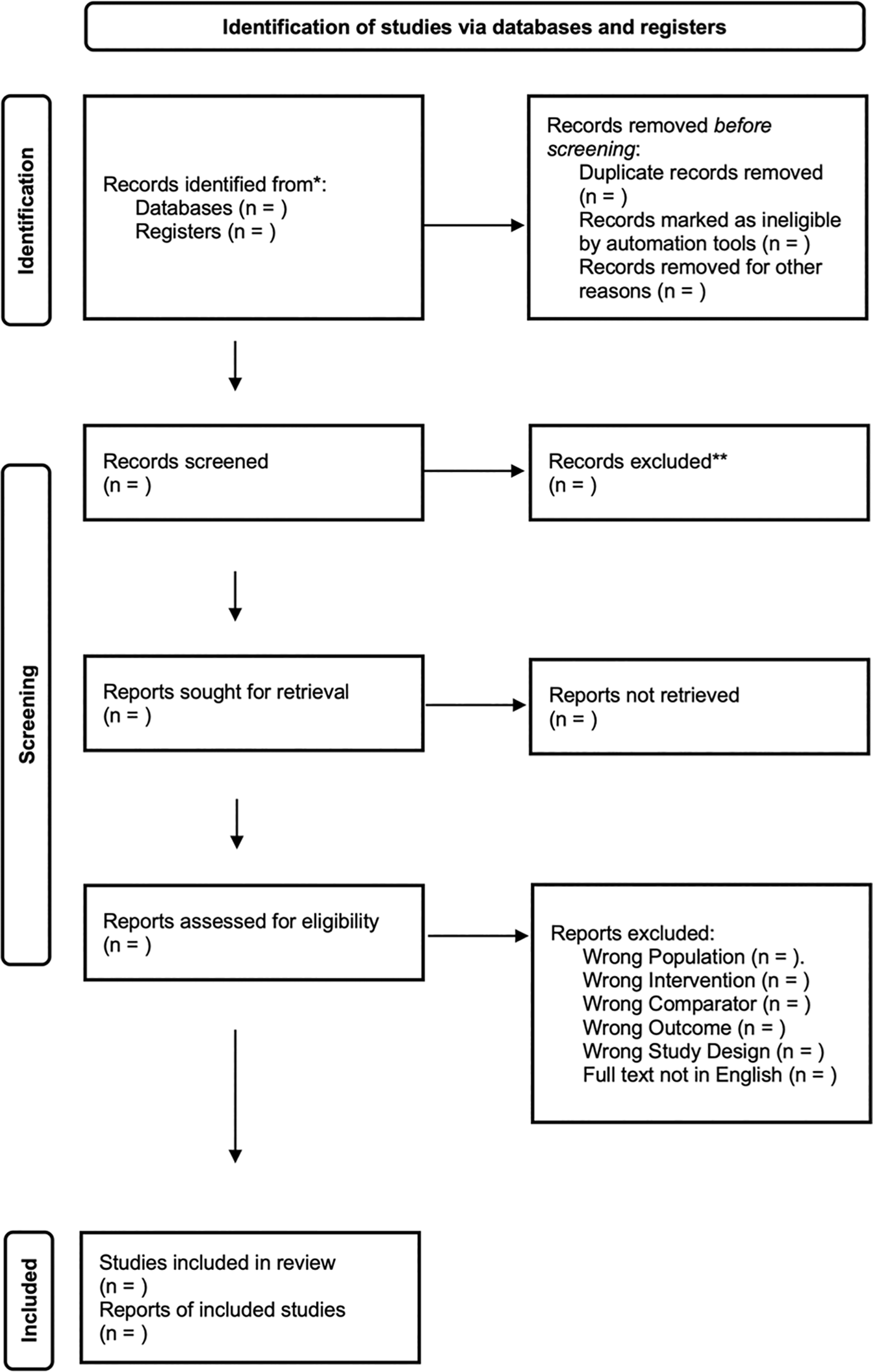
The aforementioned search keywords have been used to conduct the search on the previously listed search engines. Titles/abstracts and full texts were reviewed independently for inclusion by two reviewers using Covidence systematic review software (Innovation 2026). Any conflicts were discussed and resolved by consensus.
Data will be extracted independently by two reviewers who will also independently assess the quality of evidence for each study. Discrepancies will be resolved by an independent author and verified by a second. For each study, relevant data will be extracted using a standardised Excel data extraction template, which has been piloted in Covidence. The data to be extracted will be as follows:
Publication details: Publication title and journal/authors/year of publication/country/ setting/sponsorship source/research institution.
Methods: Study design/recruitment or referral source/availability of resource-use information.
Population: Type of cancer /inclusion criteria /exclusion criteria/ group differences at baseline/ stage of cancer / mean or median age/ gender/sample size and participant retention for each group/gender distribution in the sample.
Comparator: Comparator description/standard of care/Number of participants.
Intervention: Number of participants/Intervention components/Type of Pre vs Rehabilitation/Length of intervention/Frequency of intervention/Resources used in delivering the intervention.
Outcomes: Outcome measure/Details of measurement (scale, unit)/time point (e.g. baseline, after intervention, 6-month follow up).
Results: Mean/Standard deviation/Any other relevant data point or statistic.
The setting of the intervention must be one of hospital, home, or community. Availability of resource use information within the study or the presence of an economic analysis/commentary will be coded as Yes or No, with further information recorded within details of the intervention if yes.
Type of cancer will be coded categorically in case the study is limited to a particular type of cancer and as ‘Various’ otherwise. The stage of cancer will be coded numerically from 1 to 4. Sex/gender of the population will be expressed categorically as 0 if unclear, 1 if the population is male, 2 for female and 3 for a mixed population. For the intervention, the exact type will be recorded with 1 signifying multimodal, exercise-based rehabilitation, 2 indicating prehabilitation programmes, comprising physical exercise with one components, and 3 indicating prehabilitation programmes, comprising physical exercise with one or more additional components (e.g. education, behavioural counselling, nutritional support, or psychosocial support). For both primary outcomes, results will be recorded along with descriptions of timepoints, scale and unit of measurement, and a value variable categorising whether the results are endpoint values or recorded with respect to a baseline value.
This data will be captured for the primary outcomes VO2-Max and 6MWT. Extracted data will also record the timepoints at which the data was collected during the trials. For studies where data is incompletely reported in tables or text, graphs/charts will be analysed using Claude and ChatGPT, with consensus between the results decided by a human reviewer. Studies from which no useful data can be extracted at all will be excluded on this basis. A piloting exercise has confirmed the usefulness of this approach. All data will be cleaned in Excel or R and either exported to RevMan software (Collaboration) or analysed in R for the purposes of conducting a meta-analysis.
As this systematic review only includes randomised controlled trials, Cochrane Risk of Bias (RoB-1) will be applied for evaluating the risk of bias. Reporting bias assessment for risk of bias from missing results or participant-level missing outcome data will be assessed through RoB-1. Each study will be assessed during the data extraction phase using Covidence software by two independent reviewers. Certainty of evidence will be assessed using the Grading of Recommendations Assessment, Development, and Evaluation (GRADE) (Holger Schünemann et al., 2026) approach. The domains considered for downgrading the certainty of evidence include risk of bias, directness of evidence, consistency and precision of results, risk of publication bias, magnitude of the effect, dose-response gradient, and influence of residual plausible confounding.
Eligible RCTs will be synthesised separately for VO2 max and 6MWT outcomes. For each outcome, means, standard deviations, and sample sizes will be extracted for the intervention and comparator arms at each time point (substituted by median, IQR or any other relevant statistic depending on availability). Mean differences (MD) and 95% confidence intervals (CI) will be used as the summary effect measures, as outcomes within each analysis are measured on a common scale and in consistent units (in case the units differ for either outcome, appropriate adjustments will be made and reported, and a Standardised Mean Difference (SMD) will be calculated). Cohen’s d will additionally be reported as a standardised index to facilitate interpretability and comparison across studies, calculated as the between-group difference in means divided by the pooled pre-treatment standard deviation (33). Meta-analyses will be conducted using RevMan software and R, with inverse-variance weighted random-effects modelling. Pooled estimates for VO2-Max and 6MWT will be calculated, with subgroupings based on intervention design and cancer type. Data will be presented in text, table or graphical form, with transparent reporting of all synthesis and analysis in the manuscript or supplements.
Where standard deviations for mean change from baseline are not reported, they will be imputed using the methods described in the Cochrane Handbook (Higgins JPT 2019), assuming a within-group pre-post correlation of 0.5 as a conservative default. Where only standard errors, confidence intervals, p-values, or medians with interquartile ranges are reported, SDs will be derived. Studies that report insufficient information to compute or impute an SD, and for which a suitable proxy cannot be borrowed from a comparable study, will be excluded from the quantitative synthesis and their findings described narratively.
Statistical heterogeneity will be assessed using Cochran’s Q test (significance threshold α = 0.10, as recommended by the Cochrane Handbook (Higgins JPT 2019)). The I2 statistic will serve as the primary index for quantifying the magnitude of heterogeneity, with values of approximately 25%, 50%, and 75% interpreted as indicative of low, moderate, and high heterogeneity respectively (Higgins and Thompson 2002/06/15).
A pre-specified meta-regression will be conducted to explore the following categorical covariates: (i) age group, (ii) cancer type, (iii) intervention design based on timing (rehabilitation vs prehabilitation), (iv) follow-up horizon, (v) cancer severity, coded from reported disease stage (I–IV) at baseline, (vi) gender; with resource-use intensity as the primary moderator, coded from intervention delivery characteristics including session length and frequency, supervision level, and care setting. The meta-regression may be split up ad-hoc into multiple regressions if confounding is detected among covariates. The meta-regressions will also be adapted into subgroup analyses using categorical dummy variables wherever a sufficient number of studies (at least five) can contribute to a given analysis. This would be especially useful for determining effect sizes among major cancer types and among intervention designs to serve as guidance for conceptualising an economic model based on current evidence.
If ten or more studies are included in a given analysis, publication bias will be assessed visually using funnel plots and statistically using Egger’s test. Where fewer than ten studies are available, publication bias will be discussed narratively according to the PRISMA guidelines.
Provide sufficient details of any financial or non-financial competing interests to enable users to assess whether your comments might lead a reasonable person to question your impartiality. Consider the following examples, but note that this is not an exhaustive list:
Sign up for content alerts and receive a weekly or monthly email with all newly published articles
Register with HRB Open Research
Already registered? Sign in
Submission to HRB Open Research is open to all HRB grantholders or people working on a HRB-funded/co-funded grant on or since 1 January 2017. Sign up for information about developments, publishing and publications from HRB Open Research.
We'll keep you updated on any major new updates to HRB Open Research
The email address should be the one you originally registered with F1000.
You registered with F1000 via Google, so we cannot reset your password.
To sign in, please click here.
If you still need help with your Google account password, please click here.
You registered with F1000 via Facebook, so we cannot reset your password.
To sign in, please click here.
If you still need help with your Facebook account password, please click here.
If your email address is registered with us, we will email you instructions to reset your password.
If you think you should have received this email but it has not arrived, please check your spam filters and/or contact for further assistance.

Comments on this article Comments (0)